CernoMetric™
Understanding Your Score · v1.3.2
Return to Score PageUnderstanding Your CernoMetric™ Results
Your assessment explored how you recognize and respond to signals when making decisions.
In CernoMetric™, a signal means something important that deserves attention - an indication, warning, opportunity, anomaly, change, or red flag that should not be missed. What counts as a signal depends on the situation. In cybersecurity it might be unusual network activity. In aviation it could be a change in aircraft performance. In healthcare it might be a subtle change in a patient’s condition. In daily life it could be a child behaving unusually, a warning light appearing on your car, a change in your energy or mood, or a bill that is higher than expected. At work, it could be a customer concern, a missed deadline, a safety issue, a quality problem, or a change in team performance.
The assessment is not simply measuring whether you answered questions correctly. It examines how you distinguish meaningful signals from normal background information and how you tend to act when the evidence is uncertain.
Your results therefore describe several different aspects of judgment.
The ideas in this guide draw on the principles discussed in Signal in the Noise by CPJOIS, together with the concepts of Signal Detection Theory. The book explores how people and organizations distinguish meaningful signals from noise, how sensitivity and decision bias influence judgment, and how decisions must often be made when evidence is incomplete, uncertain, or easy to misinterpret. CernoMetric™ applies these ideas to everyday decisions, workplace situations, and other environments where people must decide what deserves attention and what can reasonably be ignored.
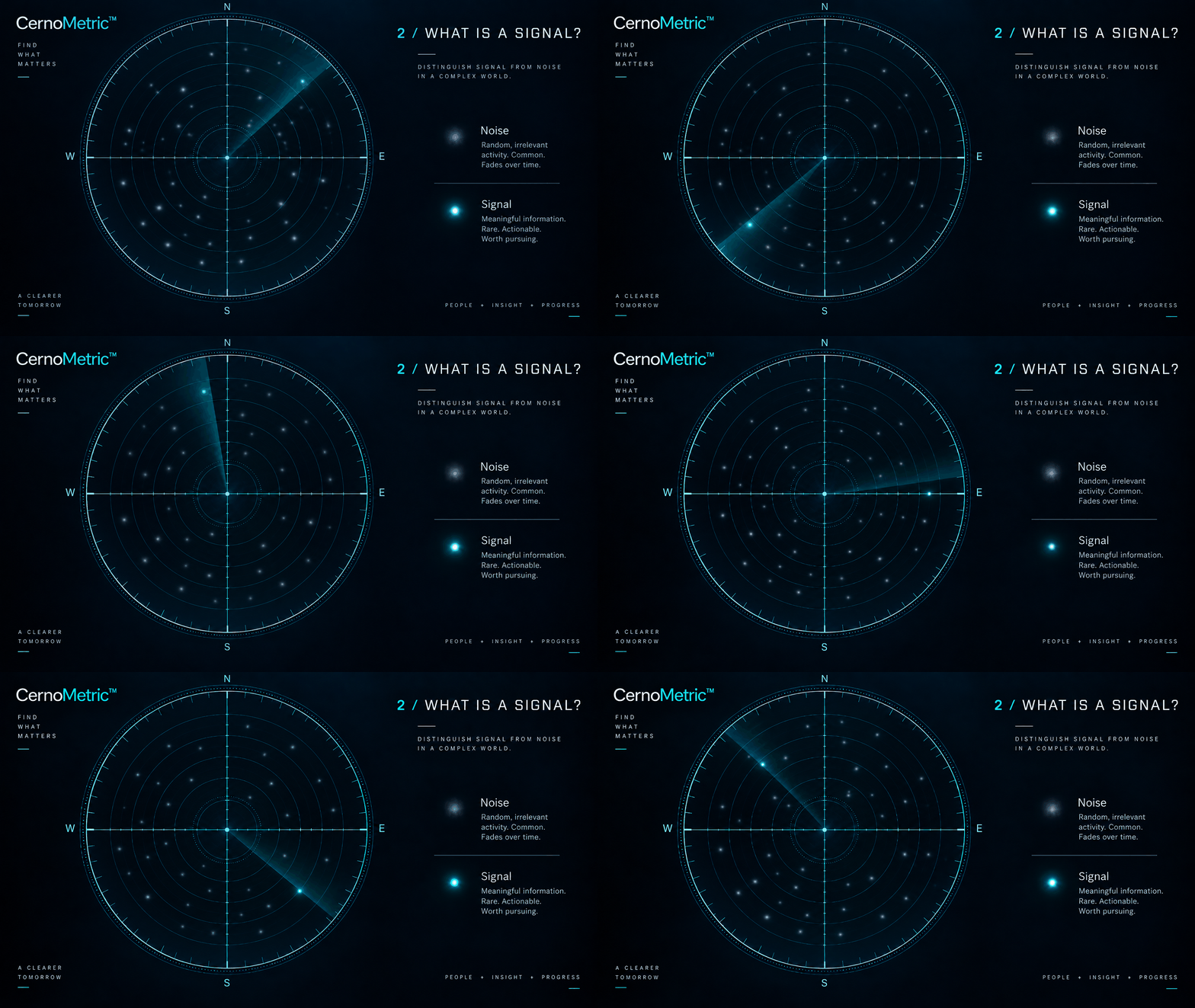
Your profile is domain-sensitive. A person may show different sensitivity and criterion patterns in driving, finance, daily life, workplace decisions, technology, or leadership. Trying multiple assessments can reveal where your judgment changes with context.
Your CernoMetric™ Score
Your CernoMetric™ Score summarizes demonstrated Ability to Discern, adjusted by Criterion Alignment. It is a decision profile rather than a grade.
Ability to Discern asks: Can you distinguish meaningful evidence from noise? Decision tendency asks: How much evidence do you require before saying yes?
For v1.3, S = 100 × max(0, 2Φ(d′/√2) − 1), B = 100 × (1 − min(|c|, 1.5)/1.5), and Score = S × (0.5 + 0.5 × B/100). Values are rounded for display. If raw d′ is zero or negative, S and the overall score are zero. Raw signed d′ remains visible.
It brings together two important characteristics of decision-making:
Ability to Discern - chance-corrected evidence of distinguishing meaningful concerns from ordinary situations.
Criterion Alignment - how close your observed threshold is to the neutral reference point. It adjusts demonstrated discernment in the composite score.
These two characteristics are related, but they are not the same.
Someone can be very good at recognizing signals while still responding too readily to weak evidence. Another person may be cautious about acting but occasionally allow important signals to pass unnoticed.
Neither tendency alone tells the complete story.
The CernoMetric™ Score provides an overall view, while the individual measures help explain how you arrived at that score.
These patterns can appear in many parts of life. A parent may notice small changes in a child’s behavior but become concerned about every minor variation. A friend may be highly attentive to changes in someone’s mood but hesitate to ask whether anything is wrong. A household manager may quickly notice unusual spending but overlook gradual increases in recurring costs. A worker may identify emerging problems early but raise concerns before enough information is available. Another worker may wait for certainty and miss an opportunity to prevent a larger problem.
Your Score May Be Different in Different Domains
Your CernoMetric™ results should not be thought of as a single, permanent measure of how good you are at detecting signals.
The same person may produce different CernoMetric™ results in different areas of life.
You might be highly sensitive to unusual events while driving because you have years of driving experience and have learned what normal traffic behavior looks like. The same person might have lower sensitivity when evaluating an unfamiliar financial situation because the relevant signals are less familiar.
Someone may recognize workplace problems very quickly but use a much more conservative decision threshold when making financial decisions. Another person may react quickly to possible safety problems while being much less likely to interpret changes in everyday routines as meaningful.
For example, your results could differ across assessments involving:
- Driving - recognizing hazards, unusual vehicle behavior, changing traffic conditions, or developing risks.
- Finance - identifying unusual transactions, spending patterns, financial risks, scams, or changes that deserve investigation.
- Daily life - noticing changes in routines, household conditions, schedules, relationships, or other everyday situations.
- Workplace decisions - recognizing quality problems, safety issues, project risks, customer concerns, changing performance, or emerging organizational problems.
- Technology and cybersecurity - distinguishing meaningful warnings or abnormal activity from routine alerts and normal system behavior.
- Leadership and management - recognizing changes in people, projects, customers, organizational performance, or the external environment.
These differences are expected.
Signal detection depends partly on experience, knowledge, familiarity, context, attention, and the consequences of being wrong. Your decision threshold may also change because the cost of a miss or false alarm is different from one situation to another.
Consider someone who hears an unfamiliar noise while driving. Because a vehicle failure could have serious consequences, that person may investigate quickly. The same person may see an unusual household expense and wait for another billing cycle before deciding that something is wrong.
The person has not suddenly become more or less capable. The domain and consequences have changed, and so has the decision process.
This is one reason CernoMetric™ assessments can be useful across multiple domains.
Build a Broader Picture of Your Judgment
Rather than treating one assessment as a complete description of your decision-making, consider completing assessments in several different domains.
You may discover that:
Your sensitivity is consistently strong across many situations.
Or you may find that it is much stronger in areas where you have substantial experience.
You may discover that:
Your decision threshold changes considerably depending on the consequences.
You might be conservative with money but liberal when responding to safety concerns.
You may also find particular environments where you tend to produce more misses or false alarms than you expected.
Those differences can be informative.
A collection of assessments can begin to create a broader CernoMetric™ decision profile showing not only how you detect signals, but where your signal-detection strengths and tendencies appear most clearly.
Try Another Assessment
After reviewing your results, consider completing a CernoMetric™ assessment in a different domain.
If this assessment focused on workplace situations, try a daily-life, driving, or financial assessment.
If you completed a general assessment, try one focused on an area where you have substantial experience - and another where you have less.
Then compare your results.
Ask yourself:
Does my sensitivity change across domains?
Does my decision criterion change?
Where do I tend to miss signals?
Where do I generate more false alarms?
Do I become more cautious when the consequences are serious?
Does experience appear to improve my ability to separate signal from noise?
The objective is not necessarily to obtain the same score everywhere.
In fact, the differences may be some of the most useful information CernoMetric™ provides.
Your goal is to better understand how your judgment changes with the situation - and whether the way you respond fits the demands of that situation.
Ability to Discern (d′)
Signal sensitivity reflects your ability to distinguish signal from noise.
In Signal Detection Theory, this is represented by a measure called d′ (d-prime).
A higher d′ generally means that you were better able to distinguish situations containing meaningful signals from situations that did not.
Think of two overlapping clouds.
One cloud represents situations where nothing important is happening. The other represents situations where a meaningful signal is present.
If those clouds overlap substantially, distinguishing signal from noise is difficult.
As sensitivity improves, the clouds become easier to distinguish.
That is what d′ attempts to measure. A negative d′ means responses ran opposite to the scenario keys; it is retained as a signed diagnostic measure. At d′ ≤ 0, the participant Ability to Discern is zero, while the raw value still positions the dot in the lower half of the four-quadrant chart. That lower half indicates no demonstrated discernment in this set.
Higher sensitivity
Higher sensitivity suggests that your responses more consistently differentiated meaningful signals from normal variation or background information.
In daily life, this might mean noticing that a routine household task is taking longer than usual, recognizing that a family member seems unusually withdrawn, or identifying that a recurring expense has changed. At work, it might mean noticing a pattern of customer complaints, repeated equipment problems, declining quality, or a team member who is struggling before the issue becomes more serious.
Lower sensitivity
Lower sensitivity suggests that signal and noise were more difficult for you to distinguish during the assessment.
This does not automatically mean poor judgment. Some scenarios are deliberately ambiguous. Experience, familiarity with the domain, uncertainty, attention, and the information available can all influence signal detection.
Sensitivity tells us primarily about your ability to discern, not about whether you tend to be cautious or aggressive in responding.
That is measured separately.
A person may have high sensitivity in one setting and lower sensitivity in another. You may be very good at noticing changes in your child’s routine but less confident interpreting financial information. You may quickly recognize technical problems at work but find interpersonal signals more difficult to interpret. Familiarity, stress, fatigue, time pressure, and the consequences of being wrong can all affect how clearly signals stand out.
Your Decision Criterion
Every decision involves a threshold.
At some point you decide:
“There is enough evidence for me to act.”
Signal Detection Theory calls this threshold the criterion, represented by c.
Your criterion helps describe how readily you interpreted uncertain evidence as a signal.
This threshold operates throughout daily life. You decide whether a noise in your home requires investigation, whether a change in someone’s behavior is worth asking about, whether a purchase is unusual enough to review, whether a minor symptom requires attention, or whether a message from a colleague needs an immediate response.
At work, you decide whether a small quality issue should be reported, whether a customer comment indicates a broader problem, whether a missed task is an isolated event, or whether a change in performance requires a conversation.
A criterion near zero
A value near c = 0 indicates a relatively balanced decision threshold.
You were not strongly inclined toward either declaring signals or dismissing them.
In everyday situations, this may look like pausing to gather a little more information before reacting, while still remaining willing to act when the evidence becomes meaningful.
A positive criterion
A positive value indicates a more conservative threshold.
You generally required stronger evidence before deciding that a signal was present.
This can reduce false alarms - but it can also increase the chance of missing subtle signals.
A conservative threshold may be useful when acting too quickly creates significant disruption. For example, you may avoid assuming that a family member is upset based on one brief response, avoid replacing an appliance because of one unusual sound, or avoid escalating a workplace concern until you have confirmed the pattern.
However, the same threshold may become risky when early action matters. Waiting for certainty before reporting a safety concern, addressing a health change, asking for help, or responding to a deteriorating work situation can allow a small issue to become larger.
A negative criterion
A negative value indicates a more liberal threshold.
You were more willing to identify uncertain evidence as a signal.
This can help detect weak or emerging signals - but it can also increase false alarms.
A liberal threshold may lead you to investigate an unfamiliar noise, check in with someone who seems different, review a suspicious transaction, ask a clarifying question, or raise a possible workplace problem before all the facts are available.
That can be valuable when the cost of missing a signal is high. It can also create unnecessary worry, interruptions, conflict, or alert fatigue when ambiguous information is repeatedly treated as evidence of a problem.
Neither positive nor negative criterion values are automatically good or bad.
The usefulness of a decision threshold depends on the situation.
Missing an early indication of a safety problem may have very different consequences from incorrectly flagging a routine business report. Similarly, overlooking a change in a child’s health may carry different consequences from becoming alarmed by every ordinary variation in behavior. At work, escalating every minor issue may overwhelm a team, while failing to report a genuine concern may expose people or the organization to greater risk.
The important question is therefore not simply:
“Do you have bias?”
A more useful question is:
“Is your decision threshold appropriate for the situation?”
Criterion Alignment
Your Criterion Alignment score translates your observed decision criterion into an easier-to-understand 0–100 measure.
It answers a different question from Ability to Discern and cannot create points when discernment is zero.
Sensitivity asks:
How well did you distinguish signals from noise?
Criterion Alignment asks:
How close was your threshold to the neutral reference point?
A score closer to 100 indicates stronger alignment.
A lower score indicates that your response threshold moved farther away from the desired criterion.
For example, a person might demonstrate excellent sensitivity but consistently require slightly more evidence than the situation warrants. That person’s signal sensitivity could be high while their Criterion Alignment score is somewhat lower.
Conversely, someone might have a well-balanced response threshold but have difficulty distinguishing weak signals from noise.
That is why these measures are shown separately.
Criterion Alignment measures distance from a neutral threshold. A neutral threshold is not always the best strategy for every situation; the costs of misses and false alarms also matter.
In daily life, the appropriate threshold may depend on whether a decision is reversible. You can usually ask a follow-up question, check a calendar, review a bank statement, or inspect a household item without major consequences. In those situations, a lower threshold for investigation may be sensible.
Other decisions may require more care. Accusing someone of wrongdoing, making a major purchase, changing a treatment plan, confronting a family member, or escalating a workplace concern can have consequences that justify gathering more evidence first.
At work, Criterion Alignment may also depend on your role. A safety officer, teacher, nurse, supervisor, technician, customer-service representative, volunteer coordinator, or team member may each have different responsibilities and different reasons to act early. A person responsible for protecting others may appropriately use a more sensitive threshold than someone whose role is to verify information before action is taken.
Hits, Misses, False Alarms, and Correct Rejections
Behind your CernoMetric™ results are four basic types of decisions.
Hit
A signal was present and you detected it.
Signal present → You identified it
Examples include noticing that a child is becoming unwell and taking appropriate action, recognizing that a household appliance is showing signs of failure, identifying a genuine fraudulent transaction, or recognizing a real safety or quality issue at work.
Miss
A signal was present but you did not identify it.
Signal present → You did not identify it
Examples include overlooking a gradual change in someone’s health or mood, failing to notice that a recurring bill has increased, dismissing repeated customer complaints as isolated events, or not recognizing that a colleague needs support.
False Alarm
A signal was not present, but you identified one.
No signal → You identified a signal
Examples include assuming someone is angry because they sent a short message, treating a normal household sound as evidence of a serious fault, reporting a routine workplace variation as a major problem, or repeatedly checking harmless activity because it feels unusual.
Correct Rejection
A signal was not present and you correctly determined that no signal was present.
No signal → You correctly rejected it
Examples include recognizing that a tired family member simply needs rest, understanding that a one-time expense is not necessarily a financial problem, dismissing a normal fluctuation in work output, or deciding that an unusual but harmless event does not require intervention.
Good judgment is not simply about maximizing hits.
If someone labels almost everything as a signal, that person may achieve many hits - but also produce many false alarms.
Likewise, someone who rarely identifies a signal may avoid false alarms while missing important events.
Signal Detection Theory evaluates these outcomes together.
Why False Alarms Are Not Always Bad
A false alarm sounds inherently undesirable, but context matters.
Imagine smoke appearing in a building.
A person who investigates immediately may occasionally react to harmless steam or dust. That produces more false alarms - but may also help detect a real fire earlier.
Similar trade-offs occur in ordinary life.
You might check on a child after hearing an unusual sound, ask a family member whether they are okay, review a bank transaction that looks unfamiliar, or inspect a car warning light that later turns out to be harmless. These actions may take time, but they can be worthwhile when the cost of missing a genuine problem is high.
Now imagine an organization receiving thousands of automated security alerts every hour.
Responding aggressively to every weak indication could overwhelm analysts and reduce attention to genuine threats.
The same pattern can occur in a school, hospital, community group, household, or workplace. If every minor disagreement is treated as a crisis, every small delay as a failure, or every unusual result as evidence of misconduct, people may become overwhelmed and begin ignoring alerts altogether.
The appropriate balance between detection and false alarms therefore depends on the costs and consequences of each decision.
CernoMetric™ is designed to help make that decision pattern visible.
Why Misses Matter
A miss occurs when a meaningful signal was present but was not recognized or acted upon.
In some environments, occasional misses may have limited consequences.
In others, a single missed signal may be extremely important.
Examples could include:
- an emerging safety problem,
- an early cybersecurity intrusion,
- a deteriorating business indicator,
- an unusual operational condition,
- an important change in customer behavior,
- a child’s worsening symptoms,
- a family member showing signs of distress,
- a recurring household expense that is gradually increasing,
- a vehicle or appliance showing early signs of failure,
- a student struggling with schoolwork,
- a colleague experiencing burnout,
- a customer repeatedly reporting the same problem,
- or a small workplace quality issue that later affects many people.
Recognizing your tendency toward misses or false alarms can help you understand how your decision threshold operates when information is incomplete.
A miss does not necessarily mean that you were careless. Sometimes the signal was genuinely difficult to detect. Sometimes you lacked the relevant information, were distracted or tired, or were operating under time pressure. Reviewing misses is useful because it can reveal whether the issue was attention, knowledge, communication, sensitivity, or the threshold you used before deciding to act.
Sensitivity and Bias Are Different
One of the most important ideas behind CernoMetric™ is that ability and decision tendency are not the same thing.
Consider two people who have identical ability to distinguish signals from noise.
One may say:
“I would rather investigate something that turns out to be nothing than risk missing something important.”
The other may say:
“I do not want to raise an alarm unless I have strong evidence.”
Their sensitivity may be nearly identical.
Their criterion may be very different.
Traditional accuracy scores can hide this distinction.
Signal Detection Theory helps separate the two.
This distinction applies across roles and responsibilities.
A parent may be highly capable of noticing changes in a child but choose to wait before reacting. A caregiver may notice subtle changes and respond quickly. A teacher may recognize that a student is struggling but differ in how soon they contact the family. A supervisor may detect a pattern in team performance but wait for more evidence before addressing it. A technician may investigate every unusual reading, while another may wait until several readings confirm the pattern.
These differences do not necessarily reflect differences in intelligence, care, or competence. They may reflect different thresholds, responsibilities, experiences, or assumptions about the consequences of being wrong.
There Is No Universal Perfect Criterion
A criterion of zero is mathematically neutral, but it is not automatically the best decision strategy for every situation.
Different environments may require different thresholds.
A safety-critical situation may appropriately favor detecting weak signals even at the cost of additional false alarms.
A situation where false alarms are extremely expensive may appropriately require stronger evidence before action.
Experienced decision-makers often adjust their threshold depending on:
- risk,
- uncertainty,
- consequences,
- available information,
- time pressure,
- reversibility of the decision,
- personal responsibilities,
- family or community expectations,
- workplace expectations,
- professional standards,
- and the cost of being wrong.
The objective is not to eliminate criterion.
The objective is to understand it and use it deliberately.
For example, you may use a lower threshold when deciding whether to check on someone who may be in danger, investigate a possible safety issue, or ask for clarification about a confusing instruction. You may use a higher threshold before making an accusation, spending a large amount of money, changing an important plan, or escalating a workplace concern that could affect another person’s reputation.
The best threshold may also change over time. A small change that is harmless once may become meaningful when it repeats. A minor workplace delay may not matter on its own, but a pattern across several weeks may deserve attention. A single missed meal may be ordinary, while a sustained change in appetite may be a signal worth discussing.
What Your Results Can Tell You
Your CernoMetric™ results can help you reflect on questions such as:
Do I recognize meaningful signals effectively?
Do I tend to require strong evidence before acting?
Do I sometimes interpret ambiguous information as meaningful too quickly?
Am I more concerned about missing important signals or about raising false alarms?
Does my decision threshold change when consequences become more serious?
Would another person looking at the same evidence reach the same conclusion?
Do I notice gradual changes, or mainly sudden and obvious ones?
Do I respond differently when the signal involves me, someone I care about, or someone at work?
Do I ask clarifying questions before deciding what an uncertain event means?
Do I adjust my threshold when a decision is reversible or difficult to undo?
These questions are often more valuable than the score alone.
Your results are not intended to label you as an alarmist, an avoider, a risk-taker, or a cautious person. They are intended to help you notice patterns in how you interpret uncertain information and decide when action is justified.
Developing Better Signal Judgment
Signal-detection performance is not necessarily fixed.
It can improve through experience, feedback, calibration, and deliberate practice.
One useful approach is to review decisions in terms of the four possible outcomes:
What did I detect correctly?
What did I miss?
Where did I raise a false alarm?
What did I correctly dismiss as noise?
Then ask a second question:
Was the problem my ability to recognize the signal - or the threshold I used before deciding to act?
That distinction is central to developing better judgment.
You can practice this in ordinary routines.
When you notice an unusual expense, record what seemed unusual and check whether it was a one-time event or part of a pattern. When someone’s behavior seems different, separate what you observed from the story you immediately formed about it. When a household item makes an unfamiliar sound, gather information before deciding whether it requires repair. When a child, student, friend, or family member seems different, ask an open question rather than assuming the cause.
At work, you can review customer feedback, missed deadlines, quality issues, safety observations, or team concerns by looking for patterns rather than reacting to isolated events. Ask whether the signal was visible, whether the information was reliable, whether the threshold for action was appropriate, and whether the consequences of waiting were greater than the consequences of investigating.
Useful practices include:
- defining what would count as a meaningful signal before reviewing the evidence,
- distinguishing observations from interpretations,
- looking for repeated patterns rather than relying only on one event,
- checking assumptions with another person,
- recording decisions and reviewing them later,
- asking what information would change your mind,
- considering the cost of both action and inaction,
- and adjusting your threshold when the consequences of missing a signal are high.
The goal is not to become suspicious of everything. It is to become more deliberate about what deserves attention.
Your Score Is a Starting Point
CernoMetric™ is intended to help make normally invisible aspects of judgment more visible.
Your score should therefore not be viewed simply as a grade.
It is a decision profile.
The most useful interpretation comes from looking at the combination of your:
CernoMetric™ Score
Signal Sensitivity (d′)
Decision Criterion (c)
Criterion Alignment
Hits
Misses
False Alarms
Correct Rejections
Together, these measures provide a richer picture of how you responded to important and ambiguous information.
The goal is not merely to detect more signals.
It is to become better at distinguishing what matters from what does not - and to understand the threshold you use when deciding which is which.
Your profile may look different across different parts of life. You may be highly sensitive to changes in your home routine but less attentive to financial patterns. You may be cautious in personal relationships but quick to act on workplace safety concerns. You may notice problems early in a technical role but hesitate to raise interpersonal concerns. These differences are worth exploring rather than judging.
Completing several CernoMetric™ assessments can help reveal these differences. Over time, your results can provide a more complete picture of where you detect signals especially well, where uncertainty is more challenging, and how your decision threshold changes across different environments.
The Bigger Idea
Every leader, professional, operator, analyst, caregiver, parent, teacher, student, volunteer, household manager, and decision-maker works in an environment filled with information.
Most of it is noise.
Some of it matters.
The challenge is recognizing the difference.
Daily life is full of signals: a change in a child’s routine, a friend who seems unusually quiet, a recurring bill that has increased, a warning light on a vehicle, a missed appointment, a change in sleep or energy, or a household task that is becoming harder to complete.
Workplaces are also full of signals: a customer who repeatedly reports the same issue, a colleague who appears overloaded, a safety procedure that is being skipped, a quality measure that is gradually declining, a student who is falling behind, a patient whose condition is changing, or a community member who needs additional support.
And sometimes the greatest risk is not that the signal was invisible.
It is that the signal was visible - but we decided it was not important enough to act upon.
At other times, the risk is that we treat every uncertain event as a signal and become too overwhelmed to recognize what truly matters.
As explored in Signal in the Noise by CPJOIS, the challenge is not to eliminate uncertainty. It is to become better at detecting meaningful signals, recognizing the influence of our decision thresholds, and reasoning more deliberately when the evidence is incomplete.
That is the problem CernoMetric™ is designed to explore.